
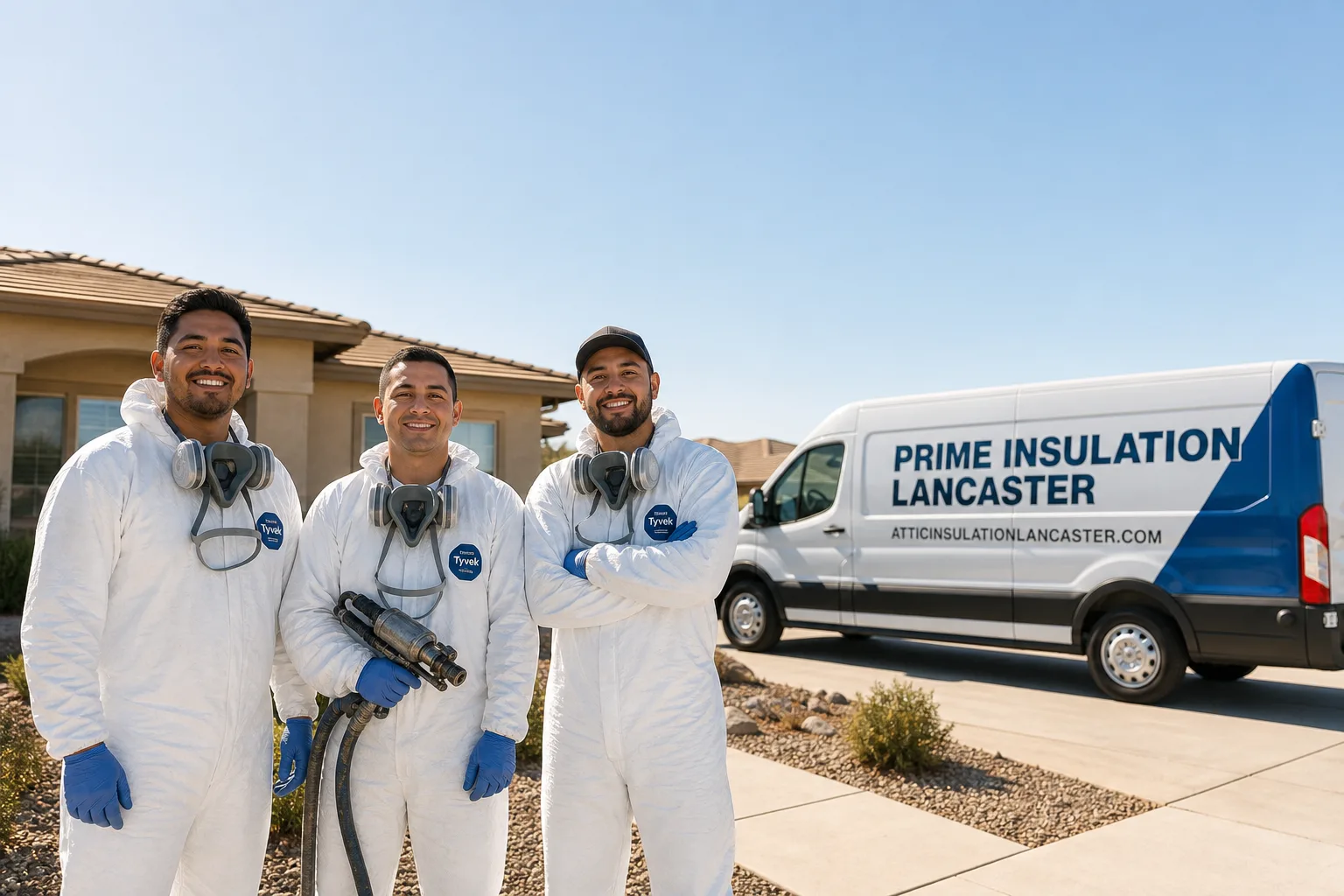
Fast, Reliable Attic Insulation Across Palmdale
If your Palmdale home was built in the 1980s or 1990s, the attic insulation above your head right now is almost certainly underperforming, likely original R-19 fiberglass that has settled, compressed, and degraded through 30-plus high-desert summers. We’re Prime Insulation Lancaster, and we work in Palmdale every week, replacing tired insulation with systems that actually hold up to 110°F July afternoons and low-20s December nights. Noel Estrada, our Owner & Lead Installer, personally oversees every Palmdale job from the first attic inspection to the final R-value check. Call (661) 545-6966 for a free estimate and we’ll tell you exactly what’s in your attic and what it should be.
Why Prime Insulation Lancaster Is Palmdale’s Preferred Attic Insulation Company
We’re not a franchise crew that parachutes in from the LA Basin. We’re based fifteen minutes up the 14 in Lancaster, and we’ve spent enough time in Palmdale attics to know what this specific housing stock needs. The tract homes in Rancho Vista, Ana Verde, and the developments east of the 14 all share a common story: built fast during the aerospace boom, insulated to 1980s code minimums, and never touched since. We know these roof geometries. We know how wind-driven air infiltration behaves off the Antelope Valley floor. And we know what happens when 150°F attic air meets a 40-year-old vapor barrier that gave up a decade ago.
Our Palmdale customers consistently tell us the same thing: they’d rather work with one person who knows the job end to end than a sales rep who hands the work to strangers. That’s how we operate. Noel quotes the job, Noel runs the job, and Noel walks the attic with you before we pack up. The person who tells you what’s wrong is the person who fixes it.
Our Attic Insulation Services in Palmdale
We don’t do a one-material-fits-all approach. Palmdale homes need different solutions depending on roof design, existing insulation condition, and whether you’re topping up or starting over. Here’s what we handle most often in this city.
Blown-In Attic Insulation
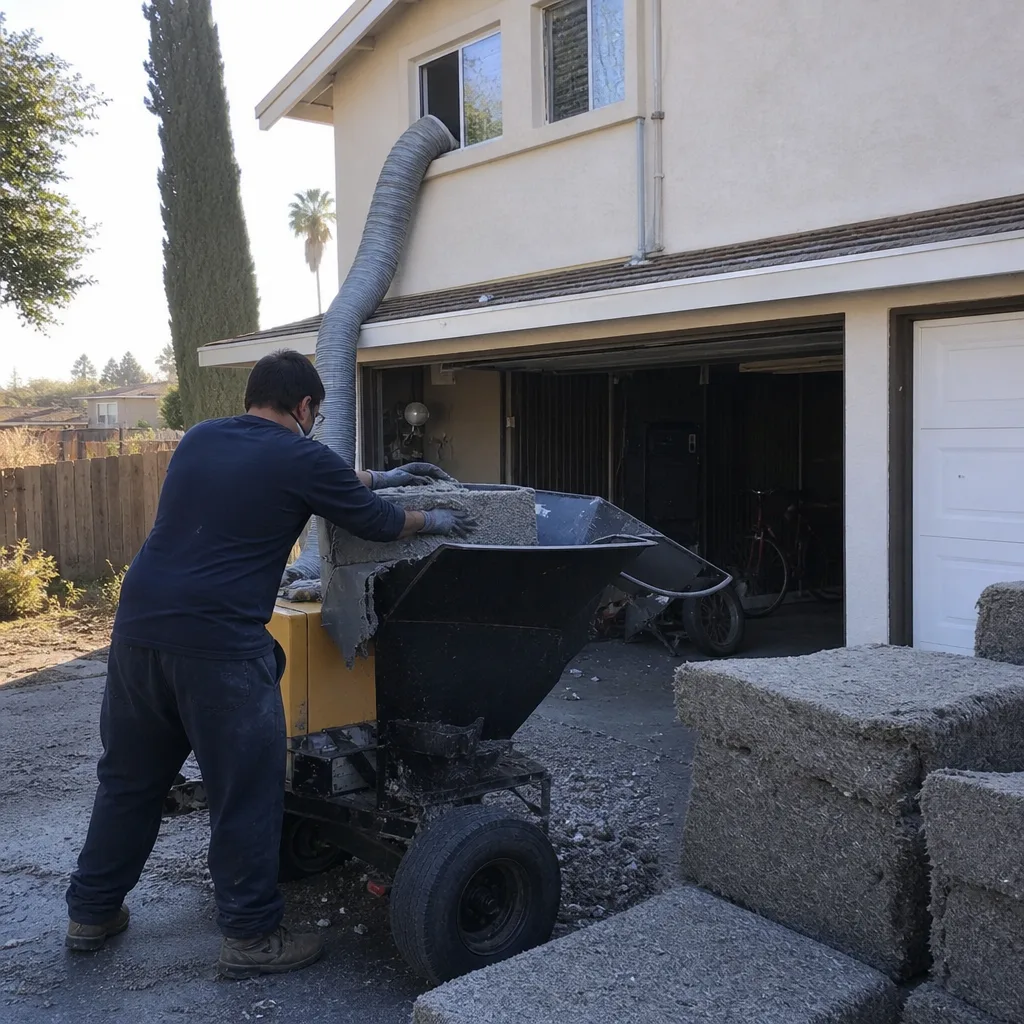
For most Palmdale tract homes with standard accessible attics, blown-in fiberglass is the fastest path from builder-grade to code-compliant. We blow Owens Corning AttiCat or Johns Manville Climate Pro to R-38 or R-49, filling every joist bay evenly across the attic floor. This is the workhorse retrofit for the 1980s and 1990s ranches that dominate Palmdale neighborhoods like Desert View Highlands and the corridors off Avenue R.
Attic Insulation Top-Up
If your existing insulation is in decent shape but just not deep enough, a top-up layer can get you to current Title 24 levels without a full removal. In Palmdale, that usually means adding 8 to 12 inches of blown-in fiberglass over settled batts. We check the existing material’s condition first. If it’s compressed, moisture-logged, or rodent-damaged, we’ll tell you straight that a top-up won’t solve the problem and recommend replacement instead.

Attic Batt Insulation
For attic spaces with unusual geometry, knee walls, or sections where blown-in material would block critical ventilation, we install Knauf or Owens Corning batt insulation. Palmdale’s hip-roof designs and vaulted-ceiling living rooms often create disconnected attic cavities that batts handle better than loose-fill. The batt product also gives us precise control in tight soffit areas where attic baffles need clearance to feed airflow.

Attic Insulation Replacement
When original insulation is beyond saving, we remove and replace it. That means vacuuming out old material, remediating whatever we find underneath (rodent droppings, and dust are common in Palmdale’s older attics), air-sealing, and installing new insulation to current code. We’re one of the few contractors in the Antelope Valley that handles full removal and replacement without subcontracting the dirty work.

Attic Baffles & Ventilation Prep
In Palmdale’s climate, attic ventilation is not optional. When soffit vents are blocked by improperly installed insulation from the 1980s, hot air stagnates and attic temperatures climb past 150°F in summer. We install baffles in every rafter bay that needs them, ensuring soffit-to-ridge airflow before any new insulation goes in. This step is critical for homes with the low-profile hip roofs so common in west Palmdale tracts.

What happens when you call
- 1
A real person answersNo phone trees — you reach a local pro.
- 2
You get an upfront price rangeHonest numbers before anyone is dispatched.
- 3
A background-checked tech heads outLicensed & insured, dispatched right away.
- 4
You approve before work beginsNothing starts until you say go.
Trusted Brands We Service in Palmdale
We install products from Owens Corning, Johns Manville, and Knauf, and we keep the materials on hand for Palmdale jobs without waiting on distribution. The brand matters less than the application, but we choose these manufacturers deliberately: their fiberglass products hold R-value through Palmdale’s extreme thermal cycling, resist moisture, and carry dependable warranties. What we won’t do is sell you a premium product when a standard one does the job, or a standard one where a premium one is needed. The home tells us what it needs.
Common Attic Insulation Problems We See in Palmdale Homes
- Settled and compressed original batts. R-19 fiberglass installed in 1988 doesn’t stay R-19. Four decades of thermal expansion and contraction leave it at 4 to 6 inches of flat, air-permeable material that performs closer to R-8 or R-10.
- Heat-degraded fiberglass binders and vapor barriers. When Palmdale attics hit 155°F in July and drop to the 20s in December, the resin binders in old batts break down. Vapor barriers delaminate and tear, creating moisture paths that mat insulation down even further.
- Disconnected attic cavities in hip-roof tract designs. The hip roofs and vaulted ceilings in Palmdale’s 1980s and 1990s ranches create separated attic spaces that trap hot air. HVAC ducts running through these unconditioned spaces can lose 30 to 40 percent of their conditioned air before it reaches a bedroom register.
- Wind-driven air infiltration off the Antelope Valley. Palmdale’s strong afternoon winds push air through every gap in your building envelope. Without proper air sealing, your attic insulation is filtering outside air rather than trapping conditioned air inside. We’ve measured air leakage in Palmdale attics that effectively negates the R-value of the insulation entirely.
Pricing for Attic Insulation in Palmdale, CA
Here are the numbers we quote most often in Palmdale, based on typical 1,800 to 2,400 square foot tract homes from 1980 to 1995: a blown-in attic insulation top-up to R-49 typically runs $1,400 to $2,600 depending on attic size and current insulation depth. Full attic insulation replacement with old material removal, air sealing, and new blown-in fiberglass to R-49 runs $3,200 to $5,800. Attic batt insulation for vaulted or hip-roof sections adds $1.50 to $2.50 per square foot of insulated area. Attic baffle installation and ventilation prep runs $250 to $600 for a typical ranch home, and we include necessary baffles on every replacement job. Every estimate is free and quoted in writing before work begins. Call (661) 545-6966 and we’ll give you an exact number for your attic, not a guess.
We Also Serve Cities Near Palmdale
Based in Lancaster, Prime Insulation serves Attic Insulation in Palmdale and the surrounding Antelope Valley communities. We also work regularly in Acton, Littlerock, Lancaster, and San Fernando, bringing the same diagnostic-first approach and owner-installed quality to every job. Our Attic Insulation team covers the entire high desert corridor, including all Palmdale ZIP codes from the 93550 neighborhoods west of the 14 to 93551 and 93552 east of Sierra Highway.
Serving Palmdale, CA — Our Local Coverage Area
We’re based in the Palmdale area and know this community well. Use the map below to see our service coverage — if you’re nearby, we can almost certainly help.
FAQs — Attic Insulation in Palmdale
No, it’s not. Original 1988 R-19 fiberglass is now performing at roughly half its rated value after 35-plus years of Palmdale’s high-desert thermal cycling, and it’s far below the current CEC Climate Zone 14 requirement of R-38 minimum with R-49 recommended. We routinely measure settled batts at 4 to 5 inches in Palmdale attics that were installed at 6 to 7 inches. The fix is a blown-in top-up or full replacement. Call (661) 545-6966 and we’ll inspect your attic and show you exactly what’s up there.
Yes, you can. Vaulted and cathedral ceilings in Palmdale tract homes often have limited cavity depth, but we can improve performance by dense-packing blown-in insulation into the existing rafter bays from the attic side, or by installing rigid board or batt insulation in accessible areas. In some cases, blown-in material is injected through small access holes in the attic knee wall without touching the drywall. The exact approach depends on your roof geometry, which is why we inspect before recommending. A pre-purchase attic inspection is a smart move in Palmdale, where original insulation is almost always inadequate.
Yes, it often does. Palmdale and unincorporated LA County enforce California Title 24 energy requirements as part of the permit process for room additions, major remodels, and certain roof work. If the work triggers an energy compliance review, your attic insulation must typically be brought to R-38 minimum, and R-49 if it’s accessible. Homeowners are frequently surprised by this at the rough inspection stage. We handle insulation upgrades for permitted remodels throughout Palmdale and can coordinate with your contractor to keep the project on schedule.
Because December nights in the low 20s create a 60-degree difference between your conditioned indoor air and the outside temperature, and your attic insulation is the only thing slowing heat from escaping through the ceiling. When that insulation is compressed, wind-infiltrated, or missing over a vaulted ceiling, your furnace runs constantly to replace heat that’s leaking straight out the roof. This is exactly the pattern we see every winter in Palmdale homes with original builder-grade insulation. Proper air sealing combined with R-49 attic coverage typically cuts heating costs 20 to 30 percent in these homes.
Yes, they can, and they do. Palmdale’s afternoon winds create positive pressure on windward walls and negative pressure on leeward walls, which pulls conditioned air out of your home through ceiling penetrations and pulls outside air in through the attic. If your attic floor isn’t air-sealed, wind effectively bypasses your insulation entirely, carrying heated air out through gable vents and ridge caps. In the Rancho Vista tract off Avenue R, our crew found a 1992-built home where the original R-19 fiberglass batts had settled to about 4 inches under a hip roof with vaulted sections. We air-sealed the top plates and blew in Owens Corning AttiCat to R-49, cutting July attic temps from 158°F to 122°F measured at the thermostat. That’s the difference air sealing plus proper insulation makes.
Ready to see what’s in your Palmdale attic? Call Prime Insulation Lancaster at (661) 545-6966 for a free, no-pressure estimate. Noel Estrada will walk the attic with you, explain exactly what’s there, and give you a written quote for the right insulation solution for your home.
Written by Noel Estrada, Owner & Lead Installer at Prime Insulation Lancaster, serving Palmdale and the Antelope Valley.