
How Much Does Blown-In Insulation Cost in Lancaster?
Blown-in insulation in Lancaster, CA typically costs between $1,200 and $3,800 for a standard single-family attic, with most homeowners landing somewhere around $1,800 to $2,400 for a 1,200 to 1,800 square foot attic brought up to R-38 or R-49. Labor and material together average $1.50 to $2.80 per square foot installed, depending on current R-value, material choice, and attic conditions – a range we see consistently across the Antelope Valley market in 2026.
Blown-In Insulation Cost Breakdown (2026)
Here’s how the numbers break down across the most common project types we see in Lancaster homes. These figures reflect actual Antelope Valley market pricing – not national averages that don’t account for our climate zone or local labor rates.
| Project Type | Typical Size | Estimated Cost Range |
|---|---|---|
| Small attic – fiberglass blown-in to R-30 | 800-1,000 sq ft | $900 – $1,400 |
| Mid-size attic – fiberglass blown-in to R-38 | 1,200-1,500 sq ft | $1,400 – $2,100 |
| Standard attic – fiberglass blown-in to R-49 | 1,500-2,000 sq ft | $1,900 – $3,000 |
| Large attic – fiberglass blown-in to R-49 | 2,000-2,800 sq ft | $2,800 – $4,200 |
| Cellulose blown-in – mid-size attic to R-38 | 1,200-1,500 sq ft | $1,300 – $1,900 |
| Cellulose blown-in – standard attic to R-49 | 1,500-2,000 sq ft | $1,800 – $2,700 |
| Top-up only (adding to existing insulation) | 1,200-2,000 sq ft | $700 – $1,500 |
| Attic air sealing + blown-in (recommended combo) | 1,200-2,000 sq ft | $2,200 – $4,000 |
| Old insulation removal + replacement | 1,200-2,000 sq ft | $2,800 – $5,500 |
A few things drive the spread within each range. Material is the first lever – fiberglass blown-in (Owens Corning, Johns Manville, Knauf) runs slightly more per bag than cellulose (GreenFiber), but fiberglass holds up better in the dry, high-heat conditions Lancaster attics see from June through September. Cellulose is denser and slightly better at reducing air infiltration on its own, which matters in older Quartz Hill and East Lancaster homes where the framing has settled and gaps have opened up over decades. Access complexity is the second lever – an attic with a single 22×30 hatch and decent headroom costs less to work in than a two-story home in West Lancaster with knee walls, multiple access points, and HVAC equipment in the way. The third is depth. Getting from R-11 (a lot of Lancaster homes built in the 1980s) to R-49 requires significantly more material than a simple top-up from R-30 to R-38.
What that table doesn’t show is the cost of skipping steps. We regularly see homes in the Antelope Acres and Del Sur areas where a previous contractor blew insulation over an unsealed attic floor, leaving a dozen penetrations wide open around can lights, top plates, and plumbing chases. The insulation looks fine from the hatch, but conditioned air is bypassing it entirely. Adding more blown-in on top of that situation achieves almost nothing. That’s why we audit the home first and air seal before a single bag goes in – it’s not an upsell, it’s the only sequence that actually works.
What Affects Blown-In Insulation Pricing in Lancaster
- Current R-value and depth needed: Lancaster falls in California’s Climate Zone 14, and Title 24 calls for R-38 minimum in attics – with R-49 being the practical target for homes that want real energy performance in our triple-digit summers. If your attic is sitting at R-11 or R-19 (common in homes built before 1990 in the downtown Lancaster core), you’re looking at a full depth install rather than a top-up, which means more material and more time.
- Attic access and working conditions: Low-pitch rooflines, limited clearance, HVAC ducts running through the space, or a single small hatch all add labor time. Ranch-style homes in Quartz Hill with 4:12 roof pitches tend to be more straightforward. Older two-story homes on the west side of Lancaster with a maze of knee walls and dropped soffits take considerably longer to work through safely and correctly.
- Existing insulation condition: Insulation that’s been contaminated by rodent activity – something we see frequently in Lancaster homes near the desert fringe on the north side of town – needs to be removed before new material goes in. Blowing fresh fiberglass or cellulose over contaminated insulation traps pathogens and voids manufacturer warranties. Removal adds cost, but skipping it costs more in the long run.
- Air sealing scope: Blown-in insulation slows conductive heat transfer. It does almost nothing to stop air movement through gaps. In Lancaster, where attic temperatures routinely hit 150°F or higher on a July afternoon, an unsealed attic floor acts like a bellows – pushing superheated air into living spaces through every penetration. Proper air sealing before installation adds to the upfront cost but is the difference between a project that pays for itself in 4-6 years versus one that never really moves the needle on your bill from Southern California Edison.
- Material choice: Fiberglass blown-in from brands like Owens Corning or Johns Manville costs slightly more per installed inch than GreenFiber cellulose, but it’s inorganic, meaning it won’t support mold growth if moisture ever enters the attic space – a real consideration in Lancaster homes near the dry lake bed where occasional moisture events can catch homeowners off guard. Mineral wool blown-in (Rockwool) sits at the higher end of the price range but offers superior fire resistance and noise attenuation for two-story homes.
- Project scope: attic-only versus whole-home: If you’re bundling blown-in attic insulation with wall insulation, crawl space work, or a radiant barrier install, the per-square-foot cost of each component typically drops because mobilization, setup, and site management costs are spread across a larger project. A homeowner in Palmdale Road-area Lancaster who combines an attic top-up with radiant barrier and crawl space encapsulation will pay less per service line than if each was scheduled separately.
Lancaster’s Climate and Why R-Value Matters More Here Than Most Places
Lancaster sits at roughly 2,300 feet elevation in the Mojave Desert, and that geography shapes everything about how insulation performs here. Summer cooling loads are extreme – daytime highs above 100°F are routine from late June through August, and attic temperatures can exceed 150 to 160°F during peak afternoon hours. That kind of radiant heat load means your insulation is working harder for longer each day than it would be in a coastal California market. Every R-value point you’re missing in the attic translates directly to your air conditioner running longer cycles and your Edison bill climbing.
Winter adds the other edge. Lancaster nights drop into the 30s and even the 20s from December through February, which is cold enough that under-insulated attics bleed heat overnight as fast as they absorb it during the day. Homeowners in the Silver Valley and Tierra Bonita neighborhoods often tell us their homes feel drafty and cold in the morning even when the heat ran all night – that’s a sign the attic floor isn’t holding the thermal boundary. R-49 in our climate zone isn’t overkill. It’s what the numbers actually justify.
This is also why we recommend a Blown-In Insulation in Lancaster assessment before deciding on R-value target alone. What looks like an insulation depth problem is sometimes an air sealing problem wearing insulation’s clothing. And sometimes it’s both. Getting the diagnosis right first is the only way to know which investment will actually move the needle on your energy bills.
Fiberglass vs. Cellulose Blown-In: Which Makes Sense in Lancaster?
Both materials work well here, but they behave differently in our specific desert conditions and the choice matters.
Fiberglass blown-in – brands like Owens Corning ProPink, Johns Manville Spider, and Knauf EcoStar – is inorganic, which means it won’t degrade if the attic sees a moisture event. It’s also lighter, which makes it easier to work with in attics that already have fragile older drywall ceilings. The per-bag cost is slightly higher than cellulose, but the installed cost difference on a typical Lancaster attic project is usually $100 to $300 total – not a meaningful decision factor on its own.
Cellulose blown-in – we use GreenFiber, which is one of the cleaner products on the market – is denser and settles into gaps and irregular framing cavities more effectively than fiberglass. It’s made from recycled paper fiber treated with borate fire retardant, which also gives it some pest-deterrent properties. For older homes in the east Lancaster neighborhoods where the framing has irregularities and the ceiling plane isn’t perfectly flat, cellulose can be the better fit. It runs slightly less per bag installed but requires more depth to hit a given R-value because it has a lower R-value per inch than fiberglass.
We carry both and don’t have an inventory reason to push either one. The call is made based on the attic, the home’s age, and what we find during the assessment.
How to Save on Blown-In Insulation in Lancaster
Apply for utility rebates before you schedule the job. Southern California Edison’s Home Energy Savings Program and SoCalGas both offer rebates for insulation upgrades that meet minimum R-value thresholds. In 2025-2026, qualified attic insulation projects have been eligible for rebates in the $200 to $500 range depending on scope and the specific program cycle. These rebates require the work to be done by a participating contractor and documentation of the pre- and post-installation R-values. Ask us about current program availability when you call – the rebate landscape shifts quarterly and we stay current on what’s active for Lancaster-area homeowners.
Bundle services in a single mobilization. If your attic also needs air sealing, a radiant barrier, or rodent proofing, scheduling those together rather than as separate projects saves on setup time and travel costs. A homeowner who calls us back six months later for air sealing after already doing a Blown-In Insulation services install will pay more in total than one who does both in a single visit. We’ll tell you honestly which additional services are actually needed and which can wait – the goal is doing the right work, not maximizing the invoice.
Don’t skip the attic assessment to save money. Buying more insulation than your attic needs is a real way to overspend. So is adding R-value to an attic with unsealed penetrations and expecting a meaningful bill reduction. A proper assessment – which we provide free as part of the estimate process – tells you exactly what depth you’re starting from, where the air leakage is, and what combination of work will deliver the best return on your investment. Skipping that step is how homeowners end up calling a second contractor two years later.
Check for PACE financing or the Inflation Reduction Act’s 25C tax credit. The federal 25C energy efficiency tax credit covers 30% of the cost of qualifying insulation improvements, up to $1,200 per year. Blown-in insulation that meets the International Energy Conservation Code minimum R-values for our climate zone qualifies. That’s a meaningful offset on a $2,000 to $3,000 project. Consult your tax professional for eligibility specifics, but it’s worth factoring into the total cost calculation before you decide.
Get the estimate, then decide. Our estimates are free, and there’s no obligation. Call us at (661) 545-6966 and we’ll take a look at the attic, measure current R-value, check for air sealing gaps, and give you a clear number with a breakdown of what you’re getting. No vague ranges, no pressure to approve something on the spot.
What the Installation Process Looks Like
Understanding what actually happens during a blown-in insulation install helps you evaluate whether a quote is complete or cutting corners.
The process at Prime Insulation starts with an attic inspection – not a glance from the hatch, but a proper assessment with a moisture meter, R-value depth gauge, and flashlight covering every section of the attic floor. We’re looking at current depth and uniformity, the condition of existing insulation, signs of rodent activity or moisture intrusion, the state of any HVAC ducts, and the location of every air leakage point: can lights, top plates, dropped soffits, plumbing penetrations, attic hatch edges.
If the attic has contaminated insulation from rodent activity – something we see regularly in homes on the north edge of Lancaster bordering open desert – removal comes first. We don’t blow new material over compromised old material. Ever. After removal, we clean and treat the attic surface, address any structural concerns, and then move to air sealing.
Air sealing comes before blown-in, always. We use spray foam to seal top plates and large penetrations, and fire-rated caulk or foam board at ceiling fixtures and framing gaps. This step adds time but it’s what separates an insulation project that actually reduces your energy bills from one that just adds depth to a leaky system.
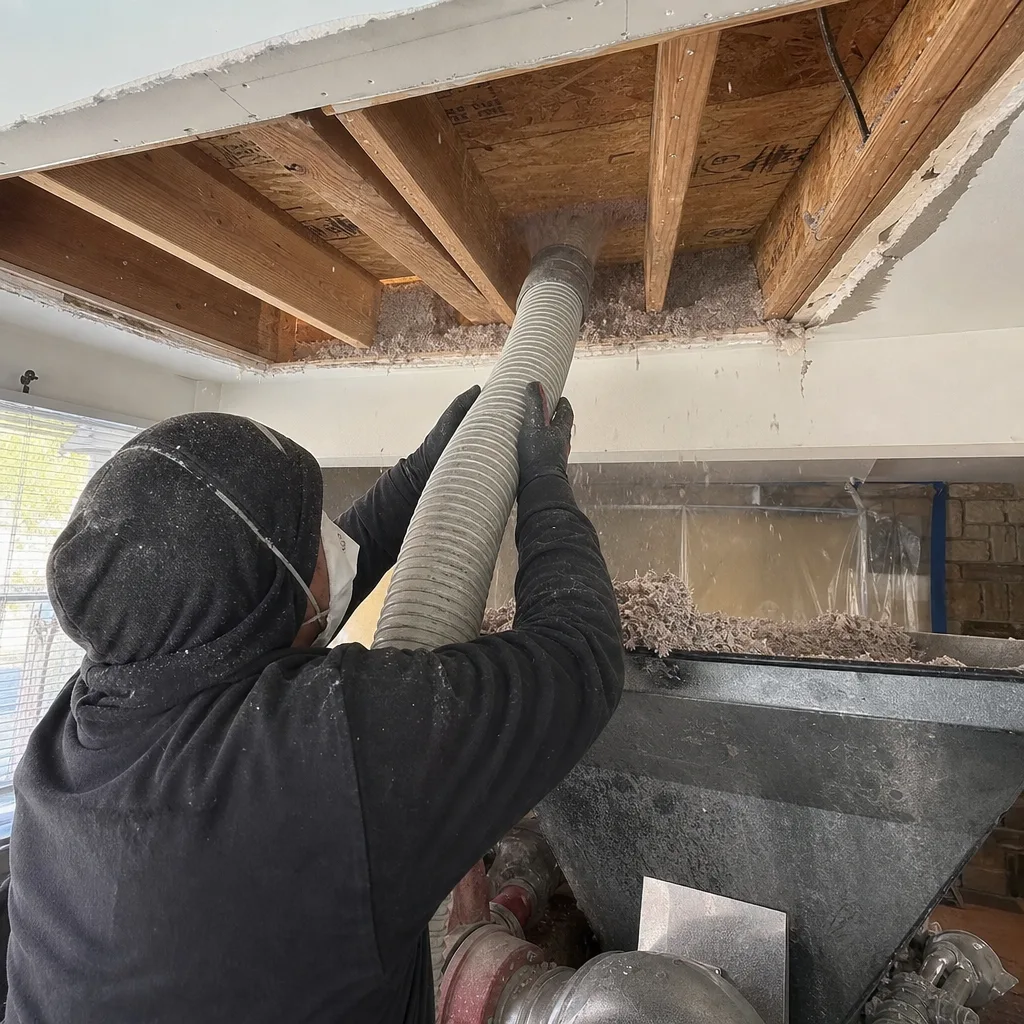
Then the material goes in. A blowing machine forces fiberglass or cellulose through a flexible hose at controlled density until the target depth – calibrated to the R-value specified – is reached uniformly across the entire attic floor. Depth gauges are set throughout so the finished result is consistent, not deep in one corner and thin near the eaves.
Final walkthrough covers eave baffles (to maintain soffit ventilation), attic hatch weatherstripping and insulation, and a re-check of depth in multiple locations. The owner oversees every step of this from assessment to final inspection – not a crew supervisor who shows up at the end, but the person who quoted the job and knows what was found during the assessment.
FAQs: Blown-In Insulation Cost in Lancaster
How much does blown-in insulation cost per square foot in Lancaster, CA?
Blown-in insulation in Lancaster runs $1.50 to $2.80 per square foot installed, including material and labor, for a standard attic project brought to R-38 or R-49. Cellulose lands toward the lower end of that range; fiberglass from brands like Owens Corning or Johns Manville sits toward the middle to upper end. Projects that include air sealing – which we strongly recommend – add roughly $0.40 to $0.80 per square foot to the total but deliver the bulk of the energy savings. Call (661) 545-6966 for a free estimate with an exact number for your specific attic.
Is it cheaper to repair or replace existing blown-in insulation in Lancaster?
A top-up to existing insulation that’s still in good condition costs $700 to $1,500 for a typical Lancaster attic – significantly less than a full removal and replacement at $2,800 to $5,500. However, if existing insulation has been contaminated by rodent activity, compressed to a fraction of its original depth, or soaked by a roof leak, replacement is the right call. Patching over compromised material wastes money. We’ll tell you which situation you’re in after the assessment – we have no interest in selling a full replacement when a top-up will do the job.
Does blown-in insulation in Lancaster qualify for rebates or tax credits in 2026?
Yes. The federal 25C tax credit covers 30% of project cost, up to $1,200, for qualifying insulation improvements – and blown-in attic insulation meeting California Climate Zone 14’s minimum R-value requirements generally qualifies. Southern California Edison’s Home Energy Savings Program has also offered rebates in the $200 to $500 range for qualified attic insulation upgrades. Rebate programs change on a rolling basis, so contact us at (661) 545-6966 to confirm what’s currently active for Lancaster homeowners before scheduling your project.
How long does blown-in insulation installation take in Lancaster?
A standard blown-in attic insulation install on a 1,200 to 2,000 square foot Lancaster home takes 4 to 8 hours for a crew performing the work correctly – including setup, air sealing, and the blown-in application itself. Projects that also involve insulation removal add a half to a full day depending on volume. We don’t rush the air sealing phase to hit a faster timeline; that step is what makes the rest of the project work. Most homeowners can expect a one-day completion for a straightforward attic project.
What R-value do I need for blown-in insulation in Lancaster, CA?
California’s Title 24 Energy Code sets the minimum for Lancaster’s Climate Zone 14 at R-38, but R-49 is the practical recommendation for homes that want meaningful reductions in cooling costs during our 100°F-plus summers. Existing homes built before 1990 in Lancaster often have R-11 to R-19 in the attic – sometimes less – which means a significant gap between current performance and what the home actually needs. We measure your existing R-value during the free estimate so the recommendation is based on where you’re starting from, not a guess.
Can blown-in insulation be installed in Lancaster walls, not just attics?
Yes. Dense-pack blown-in – typically fiberglass or cellulose installed under pressure into enclosed wall cavities – runs $1.80 to $3.20 per square foot for walls and is most common in retrofit situations where the exterior or drywall can’t be easily removed. It’s a meaningful upgrade for older Lancaster homes where wall insulation is thin or absent entirely. Attic upgrades tend to deliver faster payback in our climate because the attic is the single largest thermal boundary, but wall insulation adds real value when the attic is already at target R-value.
Key Takeaways
- Blown-in insulation in Lancaster costs $1,200 to $3,800 for most residential attic projects in 2026, with an installed rate of $1.50 to $2.80 per square foot.
- Lancaster’s Climate Zone 14 justifies R-49 in attics given our extreme summer heat loads and cold winter nights.
- Air sealing before blown-in installation is not optional if you want the project to actually reduce your energy bills – it’s the step most ‘blow and go’ contractors skip.
- Fiberglass blown-in (Owens Corning, Johns Manville, Knauf) and cellulose (GreenFiber) both work well in Lancaster; the right choice depends on your attic conditions, not what’s on the truck.
- Federal 25C tax credit (30% of cost, up to $1,200) and SCE rebates can meaningfully offset project cost – ask about current eligibility before scheduling.
- If existing insulation has rodent contamination, removal comes first. No exceptions.
- Free estimates include a proper attic assessment with current R-value measurement, not a guess from the hatch.
Get a Free Blown-In Insulation Estimate in Lancaster
If your energy bills have been climbing or rooms in your Lancaster home feel harder to keep comfortable than they should, the attic is usually the first place to look. We’ll come out, assess what’s actually there, measure current R-value, check for air sealing gaps, and give you a clear written estimate with no ambiguity about what’s included and what it costs. The owner performs the assessment and the installation – the person who quotes the job is the person doing the work.
Prime Insulation Lancaster serves homeowners throughout the Antelope Valley including Lancaster, Palmdale, Quartz Hill, Acton, and the surrounding communities. We carry eight manufacturer lines across every major insulation category, and we’ll match the material to your home’s specific needs rather than defaulting to whatever’s easiest to install. From our home base in the Antelope Valley, every project is assessed and installed with the same standard.
Call (661) 545-6966 to schedule your free estimate. We’ll tell you exactly what your attic needs and exactly what it’ll cost – no vague ranges, no surprises on the invoice.
Pricing reflects the Lancaster, CA market as of 2026. Actual project costs vary based on attic size, current R-value, material selection, and additional scope items identified during assessment. Prime Insulation Lancaster offers free, no-obligation estimates – call (661) 545-6966 to schedule yours.
What Our Customers Say
"Told me the crawlspace didn't need doing and only the attic did. Half the job, half the money."
— Jodi Mercer"Handled the utility rebate paperwork, which knocked a real amount off the final cost."
— Yusuf Khalil"Work is good and the house is noticeably more comfortable. There was insulation debris left in the hall closet under the attic access that I had to clean up."
— Miguel Martinez