
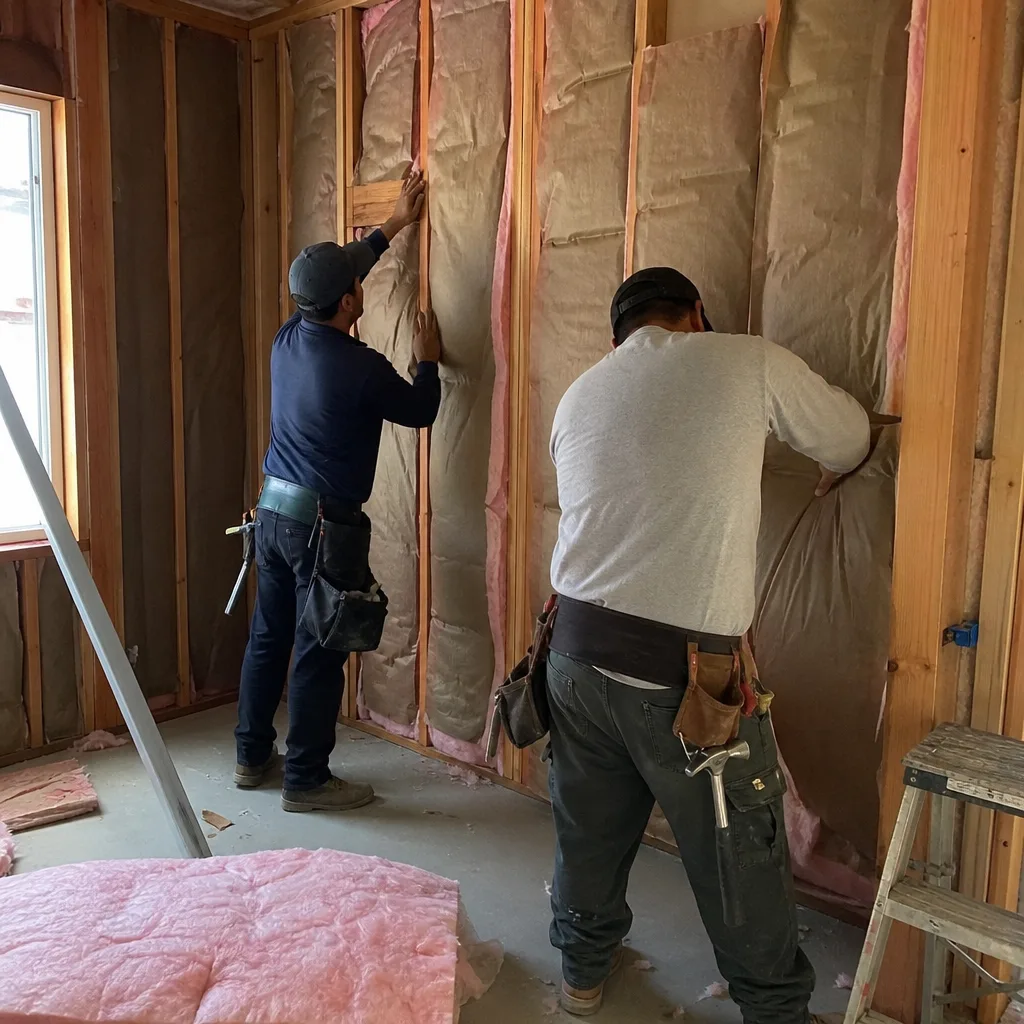
How Much Does Wall Insulation Cost in Lancaster, CA?
Our Wall Insulation services in Lancaster, CA typically cost between $1.50 and $4.50 per square foot of wall area, depending on the material, installation method, and whether existing insulation needs to be removed first. For a standard 1,500-square-foot Lancaster home, most homeowners spend somewhere between $2,200 and $6,800 for a full wall insulation project. The wide range exists because blown-in cellulose into existing walls is a very different job – and a very different price – than spray foam in an open stud bay during a renovation.
Wall Insulation Cost Breakdown (2026)
The table below reflects real installed prices we see in the Lancaster market in 2026. These are not national averages – they account for our local labor rates, material freight to the Antelope Valley, and the practical realities of working in Lancaster’s desert climate.
| Method / Material | Cost Per Sq Ft (Installed) | Typical Project Total | Best Fit |
|---|---|---|---|
| Blown-In Cellulose (retrofit, existing walls) | $1.50 – $2.50 | $2,200 – $4,000 | Existing walls without drywall removal |
| Blown-In Fiberglass (retrofit) | $1.75 – $2.75 | $2,500 – $4,500 | Existing walls, similar to cellulose but different thermal behavior |
| Fiberglass Batts (open stud bay) | $1.20 – $2.00 | $1,800 – $3,500 | New construction or remodel with drywall removed |
| Mineral Wool / Rockwool Batts | $2.00 – $3.25 | $3,000 – $5,500 | Fire resistance, sound control, open stud bay |
| Open-Cell Spray Foam (2-in application) | $2.50 – $3.75 | $3,800 – $6,000 | Open walls, excellent air sealing, moderate R-value |
| Closed-Cell Spray Foam (2-in application) | $3.50 – $4.50 | $5,200 – $6,800+ | Maximum R-value per inch, vapor control, open walls |
| Insulation Removal + Replacement | Add $0.75 – $1.50/sq ft | Add $1,100 – $2,400 | Existing degraded, rodent-damaged, or wet insulation |
A few things drive the numbers at the high or low end. Blown-in retrofit work – drilling small holes in the exterior or interior, injecting material, and patching – stays on the lower end when the walls are easily accessible and the existing cavity is clear. Spray foam in an open stud bay costs more per square foot but also air-seals at the same time, which is genuinely important in Lancaster where summer heat infiltrates through every gap around outlets, plumbing penetrations, and top plates. Homes in older neighborhoods like Quartz Hill-area tracts or the original downtown Lancaster grid often have narrower 2×4 stud bays with existing degraded batts, which adds removal cost before any new material goes in.
The other variable is linear footage of exterior wall. A single-story ranch home has proportionally more wall area relative to its square footage than a two-story with the same footprint, so per-room pricing can be misleading. We always measure wall area – not floor area – when we quote wall insulation jobs.
What Affects Wall Insulation Pricing in Lancaster
- Existing wall condition: Lancaster has a significant stock of homes built in the 1970s and 1980s – particularly in the East Lancaster and West Lancaster tracts – where original fiberglass batts have settled, shifted, or absorbed moisture from old roof leaks. Removing that material before new insulation goes in adds cost but is not optional if the new material is going to perform the way it should.
- Open vs. closed wall access: Retrofit work – insulating walls without removing drywall – costs less in labor time but typically achieves slightly lower density and R-value than open-wall installation. New construction or active remodels where studs are exposed let us use batts or spray foam to full spec. The access situation drives material choice as much as anything else.
- Stud bay depth (2×4 vs. 2×6 framing): Homes built after 2000 in newer Lancaster subdivisions like Highlands Ranch or West Wind Estates often have 2×6 exterior framing, which accommodates a thicker batt (R-19 to R-21) vs. the R-11 or R-13 that fits in a 2×4 bay. More material per bay means higher material cost, but also meaningfully better performance in Lancaster’s extreme temperature swings.
- Lancaster’s desert climate demands higher performance: The Antelope Valley hits 100-plus degrees through June, July, August, and September, then drops below freezing on winter nights. Walls that might be “adequate” in a more temperate California coastal city are genuinely undersized here. We regularly see Lancaster homeowners with R-11 walls running their HVAC 30-40% more than they should be. That climate reality pushes recommendations toward denser fill ratios and, in some cases, toward closed-cell foam on the hottest west- and south-facing walls.
- Air sealing needs: Insulation is a thermal resistor. Air sealing is what stops air movement – and in Lancaster, that convective heat transfer through gaps and penetrations in exterior walls is substantial. If wall insulation is installed without addressing outlet boxes, wire penetrations, and top/bottom plates, a significant portion of the benefit is lost. We include air sealing assessment in every wall insulation quote because the two are inseparable if energy performance is the goal.
- Whole-home scope vs. single-wall projects: Quoting a single problem wall – say, the south-facing master bedroom wall that makes the room unbearable in July – costs more per square foot than doing all exterior walls in one project. Mobilization, setup, and patching have fixed costs that spread more favorably across a larger scope. If budget is tight, we’ll prioritize the worst-performing walls first and phase the rest.
- Drywall repair and finishing: Blown-in retrofit work requires drilling holes and patching them. We handle the insulation side of that; finish carpentry and paint touch-up are typically quoted separately or handled by your GC. In a renovation with open studs, that’s not a factor.
Wall Insulation R-Value Requirements for Lancaster, CA
Lancaster sits in IECC Climate Zone 5 – the higher-demand zone that covers the inland high desert of the Antelope Valley. That matters for code compliance and for understanding why the insulation requirements here are stricter than what applies to coastal Southern California cities in Climate Zones 3 or 4.
For new construction and permitted alterations in Lancaster under California Title 24 (2022 revision), exterior wall assemblies are required to meet a minimum of R-20 in Climate Zone 5. That’s the whole-wall R-value, which accounts for the thermal bridging through studs – not just the cavity fill. In practical terms, a 2×6 wall with R-21 batts and proper installation gets you there. A 2×4 wall with R-15 batts and exterior rigid foam can also hit R-20 whole-wall, and we’ve done that combination on several retrofit projects in the older West Lancaster neighborhoods where reframing isn’t practical.
Retrofit work on existing homes – where no permit is pulled – isn’t subject to Title 24 prescriptives in the same way, but building to or near those specs still makes sense given Lancaster’s energy costs. SCE and SoCalGas utility rates in this area make every R-value point count in ways that simply don’t apply the same way in San Diego or Santa Barbara.
Wall Insulation Materials: Which One Makes Sense in Lancaster
Because we install across the full spectrum – fiberglass from Owens Corning and Johns Manville, mineral wool from Rockwool, spray foam from Icynene and Demilec, and cellulose from GreenFiber – we don’t have a financial reason to push one material over another. The recommendation comes from what the wall needs, not what’s on the truck.
Blown-In Cellulose (GreenFiber)
For retrofitting insulation into existing closed walls, dense-pack cellulose is the method that most consistently achieves full cavity fill without voids. GreenFiber’s recycled-content cellulose packs to roughly 3.5 lbs per cubic foot in dense-pack application, which is dense enough to resist settling over time. R-value runs about R-3.7 per inch, so a fully packed 3.5-inch 2×4 bay gets you to approximately R-13. In Lancaster, that’s a real upgrade from uninsulated or partially degraded original batts, though 2×6 framing gives you more room to work with.
Fiberglass Batts (Owens Corning, Johns Manville, CertainTeed, Knauf)
Batts are the right call when the stud bay is open – during a remodel, new addition, or window replacement project that exposes the cavity. Owens Corning’s EcoTouch R-21 in a 2×6 bay is a straightforward, cost-effective solution. Knauf’s EcoFill in blown application also performs consistently. The key is proper fitting: a batt that’s jammed, folded, or left with gaps at the edges delivers a fraction of its rated R-value. Correct installation matters more than the brand on the bag.
Mineral Wool / Rockwool
Rockwool batts cost more per bag than fiberglass, but they bring three things fiberglass doesn’t: fire resistance (Rockwool is non-combustible), better sound dampening (relevant in Lancaster neighborhoods near the airport or the freight rail line), and dimensional rigidity that holds its shape in the bay without friction-fit adjustment. For party walls, media rooms, or anyone who’s had a fire insurance conversation recently, Rockwool is worth the premium.
Spray Foam (Icynene, Demilec)
In open stud bays during a remodel, spray foam – particularly closed-cell at 2 inches – delivers the highest R-value per inch (around R-6.5 to R-7 per inch for closed-cell) plus a continuous air barrier in one pass. On the west-facing walls of Lancaster homes that take the full brunt of afternoon summer sun, that combination of thermal resistance and air sealing is hard to beat. Open-cell foam (Icynene ProSeal) is softer, vapor-permeable, and runs lower in cost – good for interior walls where you want sound control without the vapor retarder properties of closed-cell. High-tension warning: spray foam involves pressure vessels and chemical components that require proper personal protective equipment and training. It’s not a DIY application – the consequences of improper mixing or over-application in an enclosed wall cavity are difficult to remediate.
How to Save on Wall Insulation in Lancaster
There are practical ways to get more performance for your dollar without cutting corners on the installation itself.
- Prioritize by orientation, not by room: Lancaster’s hottest walls face south and west. If budget forces a phased approach, start with those elevations. The east-facing walls rarely need to be first in line.
- Bundle with an attic project: Wall insulation and attic insulation done in the same mobilization share setup costs. If your attic is already on the list, adding wall insulation at the same time almost always costs less per square foot than scheduling it separately.
- Get a Home Energy Audit first: We offer Home Energy Audits as a standalone service. An audit tells you exactly where the heat is getting in and gives you a prioritized list. Some Lancaster homeowners assume walls are the problem when the real culprit is attic air bypass or uninsulated ductwork in the garage. An audit makes sure the money goes where it matters most.
- Ask about utility rebates: SCE and SoCalGas both run rebate programs for insulation upgrades. Program specifics change year to year, so call us at (661) 545-6966 and we’ll walk you through what’s currently available and whether your project qualifies. We include that conversation in every free estimate.
- Choose dense-pack blown-in for retrofit jobs: If your walls are closed and the existing insulation is just degraded rather than contaminated, dense-pack cellulose retrofit is almost always the most cost-effective path to meaningful R-value improvement without major drywall work.
- Don’t skip air sealing to save money: This one sounds counterintuitive, but adding insulation R-value without addressing air infiltration at outlets, top plates, and penetrations leaves 20-30% of the potential benefit on the table. That’s not a savings – it’s money spent on insulation that can’t do its full job. We include air sealing scope in wall insulation quotes so you can see the full picture before deciding.
For a free, no-pressure estimate on Wall Insulation in Lancaster, call us at (661) 545-6966. The owner will assess the job personally – you’ll get a real recommendation, not a sales pitch.
What the Installation Process Actually Looks Like
One thing that tends to surprise Lancaster homeowners is how different the process looks depending on whether it’s a retrofit or an open-wall project. Here’s what to expect with each.
Retrofit (Existing Closed Walls)
For existing walls where drywall is staying in place, the most common method is dense-pack blown-in installation through small holes drilled at regular intervals. We drill from the exterior (through siding) or from the interior (through drywall) depending on what disruption is acceptable and what the exterior finish allows. A dense-pack nozzle is inserted into each cavity and material is blown in until the cavity is fully packed – an audible change in the machine tone tells an experienced installer when the bay is at proper density. Holes are then patched. Exterior entry is often preferred in Lancaster stucco homes because stucco patching is straightforward and doesn’t require interior painting. Interior entry is cleaner visually during the installation but leaves patched circles on drywall that need finishing.
Open-Wall Installation (New Construction or Remodel)
When studs are exposed, installation sequencing matters. Air sealing comes first: foam sealant at top plates, bottom plates, around electrical boxes, and at any penetrations. Then insulation goes in – batts are cut to fit snugly without compression or gaps, or spray foam is applied to the required depth. A final inspection of every bay before drywall closes it is the standard we hold to on every project, because a void or a misfit batt behind closed drywall is invisible and permanent. The owner is on-site for that inspection, not a crew lead relaying information by phone.
FAQs – Wall Insulation Cost in Lancaster, CA
How much does it cost to insulate walls in Lancaster, CA?
Wall insulation in Lancaster runs $1.50 to $4.50 per square foot installed, with most single-family homes landing between $2,200 and $6,800 for full exterior wall coverage. The low end reflects blown-in cellulose retrofit in a straightforward stucco home; the high end is closed-cell spray foam in an open-wall remodel. Call (661) 545-6966 for a free, site-specific estimate.
Is it worth insulating walls in an existing Lancaster home?
For most Lancaster homes with original 1970s or 1980s R-11 batts – or no insulation at all – upgrading exterior walls typically reduces HVAC runtime noticeably, often by 15-25% in peak summer months, given our Climate Zone 5 conditions. At current SCE and SoCalGas rates, the payback period on a dense-pack retrofit is commonly in the 4-7 year range depending on home size and current insulation state. That’s before any utility rebates are applied.
Can you insulate existing walls without removing drywall?
Yes. Blown-in dense-pack installation – either cellulose or fiberglass – can be done through small holes drilled in the exterior or interior without removing drywall. In Lancaster’s predominantly stucco exteriors, exterior-entry drilling and patching is often the cleanest approach. The key is reaching full-cavity density so the material doesn’t settle over time.
What R-value do walls need in Lancaster, CA?
Lancaster is in IECC Climate Zone 5, where California Title 24 requires a minimum R-20 whole-wall for new construction. For retrofits, R-13 to R-21 is the practical range depending on stud bay depth – a fully packed 3.5-inch 2×4 bay reaches roughly R-13, while a 2×6 bay with R-21 batts gets closer to code-minimum whole-wall performance. Given Lancaster’s temperature extremes, we generally recommend maximizing the cavity fill rather than stopping at the minimum.
How long does wall insulation installation take?
A retrofit dense-pack project on a standard 1,500 to 2,000 square foot Lancaster home typically takes one to two days, including drilling, injection, and patching. Open-wall batt installation on a remodel moves faster – often a single day for a full exterior envelope once studs are clear and air sealing is done. Spray foam in open walls is similar in timeline but requires cure time before drywall. We give a project-specific timeline in every estimate.
Does Prime Insulation handle wall insulation removal before new material goes in?
Yes. We offer insulation removal and replacement as a full-service scope. In Lancaster, we see this most often in older West Lancaster and East Lancaster homes where original blown-in vermiculite or deteriorated fiberglass batts need to come out before new material goes in. We also handle rodent-damaged insulation – including the cleaning and sanitizing phase before reinstallation. Starting with a clean, properly sealed cavity is the only way new insulation performs to its rated specs long-term.
Key Takeaways
- Wall insulation in Lancaster, CA costs $1.50 to $4.50 per square foot installed, with most projects falling between $2,200 and $6,800.
- Material choice depends on wall access: blown-in for existing closed walls, batts or spray foam for open stud bays during remodels.
- Lancaster’s Climate Zone 5 designation and extreme temperature range make wall insulation performance more critical here than in coastal Southern California cities.
- Air sealing and insulation should be treated as a single scope – insulation without air sealing leaves significant performance on the table.
- Utility rebates from SCE and SoCalGas may offset a portion of project cost; we walk through current programs during the estimate.
- The owner personally assesses and oversees every project – the person who quotes the job is the person doing the work.
Get a Free Wall Insulation Estimate in Lancaster
If your Lancaster home has rooms that never quite cool down in August, a heating bill that seems out of proportion to the thermostat setting, or walls that simply haven’t been touched since the house was built, a wall insulation assessment is the right starting point. We’ll measure the actual wall area, check what’s currently in the cavity, evaluate the air sealing situation, and give you a straightforward written estimate with material options and pricing. No upsell, no pressure – just an honest picture of what the project involves and what it will cost.
Call Prime Insulation Lancaster at (661) 545-6966 to schedule your free estimate. The owner picks up – not a dispatcher.
Pricing reflects the Lancaster, CA market as of 2026. Actual project costs vary by home size, existing conditions, and material selection. Prime Insulation Lancaster offers free on-site estimates – call (661) 545-6966 to schedule.
Written by the Owner & Lead Installer at Prime Insulation Lancaster, serving Lancaster, CA and the Antelope Valley.
What Our Customers Say
"Handled the utility rebate paperwork, which knocked a real amount off the final cost."
— Yusuf Khalil"Work is good and the house is noticeably more comfortable. There was insulation debris left in the hall closet under the attic access that I had to clean up."
— Miguel Martinez"Solid job. It's hard to verify what's up there once they've gone, so I'd suggest asking for photos, which they did provide when I asked but didn't offer."
— Justin Kim