
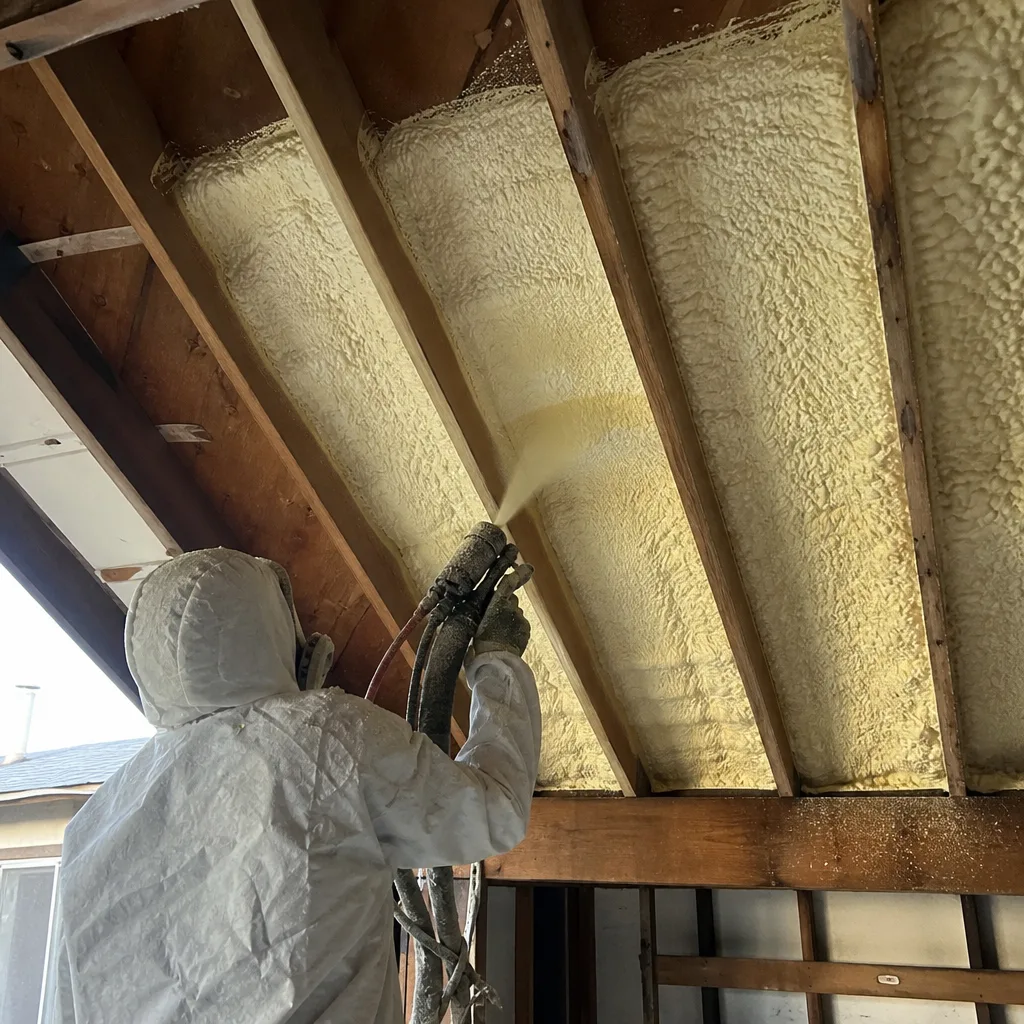
How Much Does Spray Foam Insulation Cost in Lancaster, CA?
Our Spray Foam Insulation services in Lancaster, CA typically cost between $1.50 and $4.50 per square foot, depending on foam type, application thickness, and the specific area being treated. Most Lancaster homeowners spend between $1,800 and $6,500 for a full attic or crawl space project, though whole-home jobs with open-cell and closed-cell foam combined can run higher. Getting the right number for your home starts with a free on-site estimate – call (661) 545-6966 and we’ll give you a real figure, not a guess.
Spray Foam Insulation Cost Breakdown (2026)
Below are current price ranges we see in the Lancaster market. These reflect actual project costs – material, labor, and equipment – not contractor markup estimates pulled from national databases that have never seen a Lancaster attic in August.
| Application / Area | Foam Type | Typical Cost Range |
|---|---|---|
| Attic (1,000 sq ft) | Open-cell (2 in) | $1,800 – $2,800 |
| Attic (1,000 sq ft) | Closed-cell (2 in) | $2,800 – $4,200 |
| Crawl Space Walls / Rim Joists | Closed-cell (2 in) | $1,200 – $2,500 |
| Garage Walls & Ceiling | Open-cell (3 in) | $900 – $2,000 |
| Wall Cavities (new construction) | Open-cell (3.5 in) | $1.50 – $2.25 per sq ft |
| Wall Cavities (retrofit / injection) | Injection foam | $2.50 – $4.50 per sq ft |
| Roof Deck / Cathedral Ceiling | Closed-cell (3-4 in) | $3,500 – $7,500+ |
| Rim Joists Only (standalone job) | Closed-cell (2 in) | $400 – $900 |
| Whole-Home Combination Project | Open + Closed-cell | $5,000 – $14,000+ |
A few things pull those numbers in different directions. Open-cell foam – the softer, vapor-permeable type we typically use in interior wall cavities and some attic applications – costs less per board foot than closed-cell, but you usually need more of it to hit the same thermal performance. Closed-cell foam is denser, achieves higher R-values at thinner depths, and adds structural rigidity, which matters a great deal in the Antelope Valley where roof sheathing takes a beating from high desert wind and temperature swings. The brand we specify matters too: Icynene and Demilec products, which we stock and install regularly, are commercial-grade formulations that cost more than the generic two-part kits available at hardware stores – but they cure correctly in Lancaster’s extreme summer heat and don’t exhibit the off-ratio failures we sometimes see when we’re called in to remediate a previous contractor’s work.
Labor and equipment account for a significant share of the total. Spray foam isn’t a roll-and-staple job. It requires a proportioner, heated hoses, and an operator who understands the chemistry – temperature, humidity, and mixing ratios all affect yield and R-value. In Lancaster, where summer attic temperatures regularly exceed 140 degrees Fahrenheit by mid-morning, that technical knowledge directly affects whether the foam performs as specified or delaminates within a season.
What Affects Spray Foam Insulation Pricing in Lancaster
- Foam type: open-cell vs. closed-cell. Closed-cell foam runs roughly 40-60% more per square foot than open-cell, but it delivers R-6 to R-7 per inch versus R-3.5 to R-4 for open-cell. For Lancaster’s climate zone (CEC Climate Zone 14), closed-cell is often the smarter call on roof decks and exterior-facing walls where moisture management and maximum thermal resistance matter most.
- Application thickness and target R-value. California Title 24 sets minimum R-values for Lancaster residential projects. Attic floors typically need R-38 or higher to meet current code, and if you’re going conditioned attic (foam the roof deck instead of the floor), you need enough closed-cell depth to hit an equivalent performance rating. More inches means more material, and material is where the bulk of spray foam cost lives.
- Area size and accessibility. A tight crawl space under a 1950s Lancaster tract home off 10th Street West is a very different job than spraying an open attic in a newer build in the Quartz Hill area. Confined spaces require more labor time, additional safety precautions, and sometimes smaller equipment – all of which affect price. Don’t let a contractor quote your job without physically seeing those spaces first.
- Existing insulation removal. Many Lancaster homes still have original fiberglass batts from the 1970s and 1980s, sometimes contaminated with rodent droppings or degraded from years of heat cycling. If the existing material needs to come out before spray foam goes in – and it often does – that’s an additional cost, typically $500 to $1,500 for a standard attic. We handle insulation removal in-house, so there’s no coordination gap between the demo crew and the installation crew. The same team that clears the attic is the team that sprays it.
- Attic air sealing before foam application. This is where a lot of contractors cut corners. Proper spray foam performance in Lancaster depends on sealing penetrations – top plates, recessed light cans, plumbing chases, HVAC drops – before or as part of the foam application. If you skip air sealing and just spray foam over existing gaps, you’re still moving conditioned air into the attic. We perform attic air sealing as a defined step, not as an afterthought, and yes, it adds time and cost. It also makes the spray foam actually work.
- Desert climate conditions and timing. The Antelope Valley’s extreme temperature swings – Lancaster summers routinely hit 105 degrees Fahrenheit or more, and winter nights drop into the low 30s – create installation windows that matter. Spray foam applied in peak afternoon summer heat requires adjusted equipment settings and experienced operators. Jobs scheduled during moderate temperatures are typically faster, which can affect labor cost slightly. We’re upfront about this during the estimate.
Open-Cell vs. Closed-Cell Foam: Which One Does Lancaster Actually Need?
This is the question we field most often during estimates in Lancaster, and there isn’t a single universal answer – which is exactly why we audit the home before recommending anything. Here’s how we think about it.
When Open-Cell Foam Makes Sense
Open-cell foam is the right call for interior wall cavities, interior attic knee walls, and sound-dampening applications like garage ceilings under living spaces. At R-3.5 to R-4 per inch, it’s less thermally dense than closed-cell, but it’s vapor-permeable – it allows moisture to pass through and dry rather than trapping it. In Lancaster’s dry high desert climate, vapor-permeable foam in interior locations is often perfectly appropriate. It’s also softer and less brittle under the kind of thermal expansion that comes with a Lancaster summer, which matters in wall cavities where temperature differentials are moderate.
When Closed-Cell Foam Is the Right Call
Closed-cell foam is what we typically specify for roof decks, exterior-facing rim joists, crawl space walls, and any application where you need both thermal resistance and vapor control in a thin profile. In Lancaster’s conditioned attic conversions – where we’re spraying the underside of the roof deck rather than the attic floor – closed-cell at 3 to 4 inches delivers R-18 to R-28, enough to keep the attic space within a reasonable range of conditioned space temperatures even in peak July heat. It also adds measurable rigidity to roof sheathing, which matters in the Antelope Valley’s wind corridor.
We carry both Icynene and Demilec product lines and select between them based on the specific application requirements of your home – not based on which pallet is sitting closest to the truck. That’s what material-agnostic actually means in practice.
Is Spray Foam Worth the Cost in Lancaster, CA?
We don’t push spray foam on every job. For some Lancaster homes, blown-in cellulose at R-60 on the attic floor is the right answer and costs significantly less. For others – particularly homes with HVAC equipment living in a vented, unconditioned attic baking at 140 degrees while the air handler sweats and leaks duct connections – converting to a closed-cell conditioned attic is one of the highest-ROI improvements the home can make. We’ve seen cooling loads drop meaningfully after a proper conditioned attic conversion in neighborhoods like West Lancaster and the older grid streets north of Avenue J, where tract homes from the late 1970s have original ductwork running through unconditioned attic space.
The math usually works out to a payback period of 4 to 8 years on energy savings alone in Lancaster’s climate, depending on existing insulation conditions, HVAC efficiency, and how much the current building envelope is leaking. We can walk you through that math during a home energy audit, where we look at the whole building envelope before recommending a single product.
What spray foam does better than any other insulation type is eliminate air movement simultaneously with adding thermal mass. A high R-value batting that’s air-permeable loses a significant portion of its stated performance in a leaky attic. Spray foam eliminates that variable. In Lancaster, where Antelope Valley winds create significant pressure differentials across the building envelope, that air-sealing function is not a minor bonus – it’s often the primary reason we specify it.
How to Save on Spray Foam Insulation in Lancaster
Get the Scope Right Before You Commit
The most common way Lancaster homeowners overpay for spray foam is by agreeing to treat areas that don’t need it, or treating areas with spray foam when a less expensive product would perform equally well. We run a proper assessment before any proposal goes out. If blown-in insulation on the attic floor gets you to your energy goals for half the price, we’ll tell you that – even though spray foam pays us more.
Bundle the Work
If your home needs attic cleaning, rodent proofing, air sealing, and new insulation, doing all of it in a single project saves meaningful money compared to scheduling each as a separate job. Equipment is already on-site, the attic is already prepped, and mobilization cost is a one-time line item. We handle every one of those services in-house, so bundling doesn’t mean coordinating multiple contractors – it means one crew, one schedule, one point of contact.
Check for Utility Rebates and California Energy Incentives
Southern California Gas and Southern California Edison periodically offer rebates on insulation upgrades for qualifying homes. California’s Energy Upgrade California program has also provided incentives for building envelope improvements. These programs change frequently, so we recommend checking current offerings at the time of your project. We can point you toward the current incentive landscape during your estimate – it’s not unusual for rebates to offset $200 to $800 of a Lancaster insulation project’s cost.
Don’t Skip the Home Energy Audit
Spending a few hundred dollars on a proper energy audit before committing to a spray foam project can save you from spending thousands on the wrong solution. If the audit reveals your biggest energy losses are coming from duct leakage rather than insulation gaps, for example, addressing the ducts first changes the entire project scope. We offer Home Energy Audits as a standalone service for exactly this reason.
Call for a Free On-Site Estimate
We don’t charge for estimates in Lancaster or anywhere else in the Antelope Valley. An on-site visit is the only way to give you a number that actually reflects your home’s specific conditions – square footage, existing insulation state, access constraints, and what the job actually requires. Call (661) 545-6966 and we’ll schedule a time that works for you.
What’s Included in a Prime Insulation Spray Foam Project
Before a single board foot of foam goes into your Lancaster home, we do a proper site assessment. That means walking the attic, checking existing material conditions, identifying air bypass locations, and confirming the substrate is ready to accept foam correctly. If we find old, contaminated, or compacted insulation that needs to come out first, we handle that removal ourselves rather than leaving it to you to coordinate separately.
The owner is on-site during the work. That’s not a marketing line – it’s how Prime Insulation operates. The person who walked your attic during the estimate is the person overseeing the installation. There’s no handoff to a crew you’ve never met. That direct accountability is something rotating subcontractor models structurally cannot offer, and it matters when the work involves a product like spray foam that, done incorrectly, is expensive to remove and redo.
After installation, we do a post-application inspection to confirm coverage, thickness, and adhesion before we leave the site. If you’ve had spray foam work done before and weren’t given that walkthrough at the end, that’s a gap in the process – and unfortunately it’s common.
For Lancaster homeowners who need more than insulation, our full service lineup covers Spray Foam Insulation in Lancaster, blown-in insulation, radiant barrier installation, crawl space encapsulation and vapor barriers, attic air sealing, insulation removal and replacement, attic cleaning and rodent proofing, and home energy audits. The goal is a complete building envelope, not a patched one.
Local Cost Context: Why Lancaster Pricing Differs From National Averages
If you’ve looked up spray foam costs online and seen national averages of $1.00 to $2.00 per square foot, those figures don’t reflect what you’ll actually pay in Lancaster, CA. A few reasons for the gap.
First, California labor costs are higher than the national average, and insulation contractors operating in Lancaster are subject to California contractor licensing requirements, workers’ comp insurance, and material costs that reflect shipping into the high desert rather than being local to a major distribution hub. A legitimately licensed and insured California contractor cannot compete on price with unlicensed operators, nor should a homeowner want them to.
Second, the performance requirements for Lancaster’s climate are more demanding than many regions. California Title 24 energy standards for Climate Zone 14 specify higher minimum R-values than most other states, and achieving those values with spray foam requires more material depth than a baseline national estimate assumes.
Third, Lancaster’s extreme summer heat creates application challenges that experienced local contractors account for in their equipment and scheduling. A contractor without experience in the Antelope Valley’s climate may underestimate the job requirements – and you’ll see the consequences in foam that doesn’t cure correctly or doesn’t hit rated R-values at installed thickness.
The right price for a spray foam project in Lancaster is the price that accounts for all of those realities. An unusually low bid is usually missing one of them.
FAQs – Spray Foam Insulation Cost in Lancaster, CA
How much does spray foam insulation cost per square foot in Lancaster?
In Lancaster, spray foam insulation costs between $1.50 and $4.50 per square foot installed, depending on foam type and application. Open-cell foam runs $1.50 to $2.50 per square foot for most interior applications. Closed-cell foam – which Lancaster homes often need on roof decks and exterior-facing assemblies – runs $2.80 to $4.50 per square foot. Equipment, labor, and California-market material costs all contribute to pricing that’s higher than many national online calculators suggest. Call (661) 545-6966 for a free on-site estimate specific to your home.
Is closed-cell or open-cell foam better for a Lancaster home?
Closed-cell foam is typically better for roof deck applications, crawl space walls, and any exterior-facing assembly in Lancaster’s Climate Zone 14, where thermal resistance and vapor control in a thin profile matter most. Open-cell foam is appropriate for interior wall cavities, interior attic knee walls, and sound dampening. Most whole-home spray foam projects in Lancaster use a combination of both types, with the choice driven by the specific location and performance requirement – not by which product is easier to apply. We carry both Icynene and Demilec lines and specify based on your home’s actual conditions.
How long does spray foam insulation last in Lancaster’s desert climate?
Properly installed closed-cell spray foam has an expected service life of 20 to 30 years or more in residential applications. Open-cell foam is similarly durable in protected interior locations. In Lancaster’s high desert climate, the bigger durability risk is improper installation – foam applied at incorrect ratios or temperatures can delaminate, shrink, or fail to achieve rated R-values within a few years. This is why we inspect existing spray foam work before quoting any project that involves topping up or adding to a previous application. If the existing foam has problems, adding more material on top doesn’t fix them.
Can spray foam insulation lower my energy bills in Lancaster?
Yes – measurably. Lancaster homeowners with unconditioned attics and aging ductwork often see cooling costs drop significantly after a conditioned attic conversion using closed-cell spray foam on the roof deck. The combination of eliminating attic air leakage and keeping HVAC equipment in a conditioned space (rather than an attic exceeding 140 degrees in summer) reduces system run time and improves equipment efficiency. Payback periods on properly scoped projects typically run 4 to 8 years based on energy savings alone in Lancaster’s climate, with longer system life for the HVAC equipment as an additional benefit. A home energy audit before the project helps confirm whether spray foam is the right solution for your specific energy loss pattern.
Do I need to remove old insulation before installing spray foam?
It depends on the condition and location of the existing material. For attic floor applications where we’re converting to a conditioned attic by spraying the roof deck, the existing attic floor insulation often stays in place and adds to the total R-value. But if the existing material is contaminated with rodent activity, wet, severely compacted, or is an older loose-fill that doesn’t adhere well beneath spray foam, removal is the right call – typically adding $500 to $1,500 to the project cost for a standard Lancaster attic. We assess this during the free estimate and give you a straight answer rather than discovering it midway through the job. We handle removal in-house, so there’s no separate contractor to schedule. Call (661) 545-6966 to set up your free assessment.
Key Takeaways: Spray Foam Insulation Pricing in Lancaster
- Typical Lancaster spray foam projects run $1,800 to $6,500 for single-area work; whole-home jobs can reach $14,000 or more.
- Open-cell foam costs $1.50 to $2.50 per sq ft; closed-cell runs $2.80 to $4.50 per sq ft in the Lancaster market.
- Lancaster’s Climate Zone 14 requirements, extreme summer heat, and California labor costs make local pricing higher than national averages.
- Attic air sealing and, where needed, insulation removal should always be part of the project scope – not optional add-ons.
- Utility rebates and California energy incentives can offset $200 to $800 of total project cost for qualifying homes.
- The owner installs the work personally – not a crew hired after the estimate is signed.
- Free on-site estimates in Lancaster and the Antelope Valley – call (661) 545-6966.
Get a Free Spray Foam Estimate in Lancaster
If you’re trying to figure out whether spray foam makes sense for your home, the fastest way to get a real answer is to have someone who knows Lancaster’s building stock actually look at it. We’ve worked in homes across Lancaster – from the older wood-frame tract houses in the grid streets north of Lancaster Boulevard to newer builds in areas like West Lancaster and Quartz Hill – and the right solution isn’t the same for all of them.
Our estimates are free, on-site, and come with a straight explanation of what we found and why we’re recommending what we’re recommending. No pressure to commit on the day. If the job needs a home energy audit first to narrow down the scope, we’ll tell you that too.
Call (661) 545-6966 to schedule your free estimate with Prime Insulation Lancaster. We’ll walk the attic with you, tell you exactly what we see, and give you a real number for your specific home.
Pricing reflects the Lancaster, CA market as of 2026. Actual project costs vary based on home size, existing conditions, foam type, and current material pricing. Prime Insulation Lancaster offers free on-site estimates – call (661) 545-6966 to schedule yours.
Written by the Owner & Lead Installer at Prime Insulation Lancaster, serving Lancaster, CA and the Antelope Valley.
What Our Customers Say
"He did a blower door test before and after and gave me the numbers. I like being able to see the difference rather than being told about it."
— Renee Parker"Found and sealed a gap around the chimney chase that was basically an open chimney to the attic."
— Karen Park"Spray foam in the rim joists in the basement. The cold floors above them are gone."
— Michelle Yang